Off-Street Parking Reform
Introduction
Ukiah’s 2040 General Plan Mobility Element requires the City to promote a balance of multi-modal options to improve circulation. After evaluation by the Community Development and Public Works Departments, Staff determined that the City’s existing off-street parking requirements include activity-specific ratios that no longer reflect modern demand patterns or uses. These outdated standards, along with other inefficiencies, result in the oversupply of parking, underutilized paved areas, and unnecessary costs for new development.
To address these considerations, City Staff drafted regulatory updates to align Ukiah’s off-street parking regulations (UCC Chapter 2, Article 17) with the 2040 General Plan’s mobility goals, standardize parking requirements across zoning districts, and promote alternative transportation infrastructure.
Overview of Proposed Parking Code Changes
The City of Ukiah is proposing amendments to Article 17, Chapter 2, Division 9 of the Ukiah City Code across five key areas: parking space dimensions, surfacing and lighting, parking ratio consistency, bicycle parking, and administrative flexibility.
Parking Space Dimensions Minimum parking stall dimensions would become more flexible to encourage more efficient use of parking areas. The share of a lot that may be designated for compact spaces would also increase from 30% to 40%. A new dimensional table and parking diagram, adapted from the City of Santa Rosa, would be added to provide guidance on a broader range of configurations, including angled, parallel, and alternative stall layouts.
Surfacing and Lighting The updated code would explicitly encourage permeable paving materials, including permeable asphalt, concrete, and interlocking pavers, where site conditions allow. These surfaces would remain subject to City Engineer approval. Parking lot lighting would be required to use downcast, shielded fixtures to reduce light spillover onto adjacent properties.
Parking Ratio Modernization The current code contains a lengthy, use-specific list of parking ratios that is difficult to apply consistently and has not kept pace with how land uses have evolved. The proposed amendments replace that list with a streamlined set of consolidated categories, deferring applicable standards to individual zoning district requirements or the site development permit review process. The update also corrects a longstanding discrepancy in which revised residential parking standards adopted as part of the City’s housing reform efforts were never carried over into the off-street parking regulations.
Bicycle Parking A new code section (§9200), adapted from the City of San Jose, establishes design and siting standards for bicycle parking, covering rack anchoring, spacing, maneuvering clearance, proximity to building entrances, and signage. For commercial developments where the use is determined at the time of permit, a minimum of 10% of required automobile parking spaces must be provided as bicycle spaces. Bicycle parking spaces would count toward the required automobile parking total, allowing them to reduce the number of vehicle spaces otherwise required. The existing substitution allowance would also expand from a maximum of two to three vehicle spaces per parcel.
Administrative Flexibility This is the most consequential change in the proposed ordinance. Under current code, any reduction in parking minimums requires a formal Variance, a quasi-judicial process that demands findings of special circumstances and can be costly and time-consuming for applicants. The proposed amendments would allow the Zoning Administrator or Planning Commission to approve parking reductions through standard discretionary permit review, without a Variance. Proximity to transit or bicycle infrastructure and shared parking arrangements would serve as straightforward justifications for reduced ratios, making it faster, less expensive, and more predictable for property owners and developers to seek relief from standard requirements.
Parking District No. 1
Ukiah City Code Section 9199(A)(1) states:
All existing commercial structures as of January 1, 1979, within the area defined as the City of Ukiah Parking District No. 1, shall be exempt from the required off-street parking requirements prescribed in section 9198 of this article. This exemption applies to changes in the structure, a sale of the property or business or expansion into existing structure space. New commercial construction including demolition, reconstruction, structural additions and existing or new residential uses within said district are not exempt. The exemption provided in this section does not require variance approval by the planning commission or the city council.
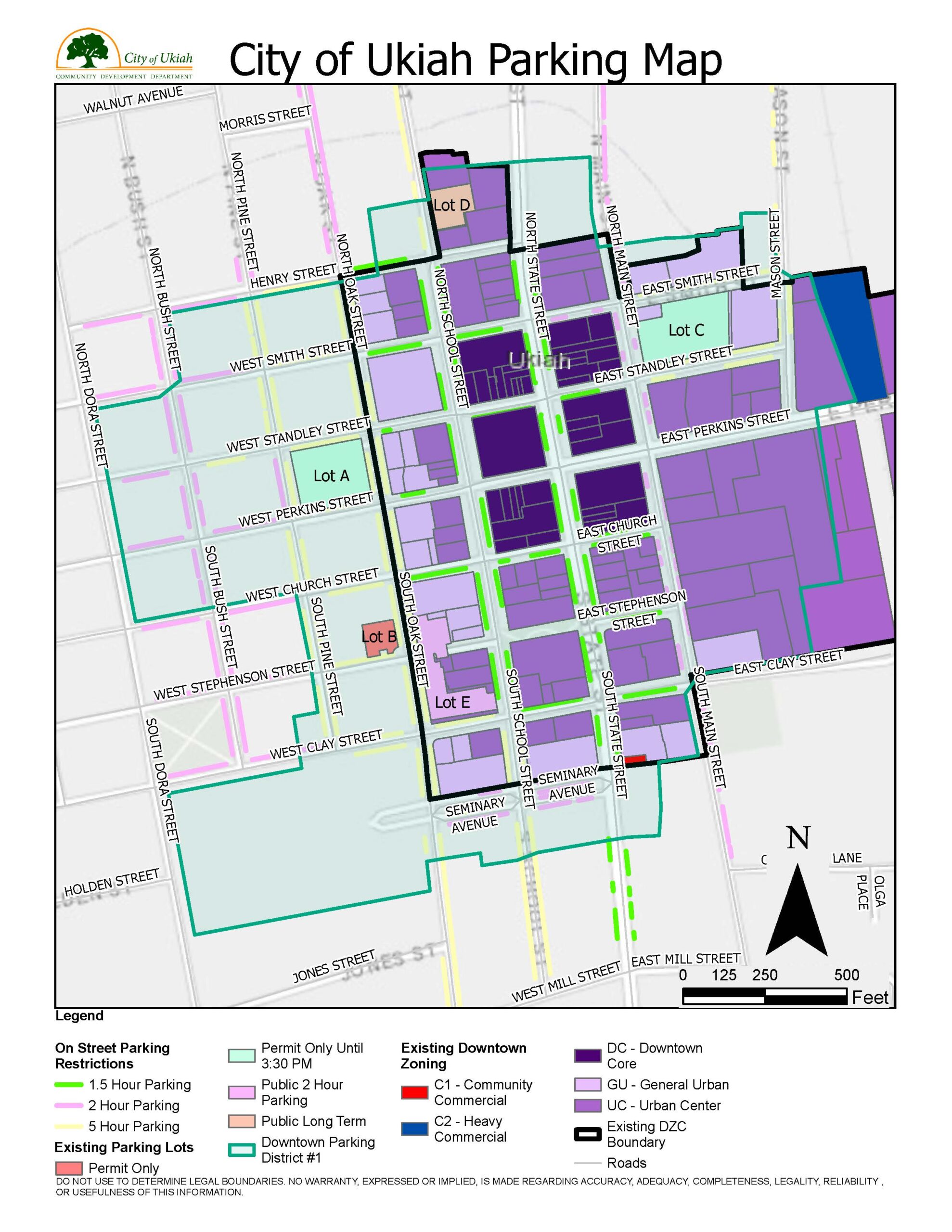
Currently, the parking exemption excludes new construction, demolition, rebuilding, structural alterations, and residential uses from using the exemption.
A potential discussion could explore removing those exclusions, which would extend the parking exemption to new construction or adaptive reuse projects, allowing the parking improvements for the Parking District to be determined by market considerations rather than minimum requirements.
This would be a relatively modest regulatory change, but one with meaningful implications. It would also bring Ukiah in line with a growing trend across California and the country toward eliminating minimum parking mandates, particularly relevant in areas where the built environment is oriented around commercial, institutional, and multifamily uses.
Parking Standards - Ukiah Examples
Below is a short list featuring commercial parking standards that appear mismatched to most new development or adaptive reuse projects:
§9198(C)(1): Bowling Alleys And/Or Billiard Halls: Four (4) parking spaces for each bowling lane, and two (2) per billiard table, plus such additional spaces as may be required for affiliated uses such as bars, restaurants, or offices
§9198(C)(5): Pitch And Putt And Miniature Golf Course: Three (3) parking spaces per hole plus the spaces required for accessory uses on the site.
§9198(B)(8): Funeral Homes And Mortuaries: One parking space for each three (3) seats in each chapel or parlor room, plus one space for each funeral vehicle kept on the premises, plus two (2) spaces for office space.
§9198(B)(4): Coin Operated Laundromats Or Dry Cleaning: One for each three (3) washing machines.
These parking requirements reflect a mid-twentieth century approach to zoning that was once standard practice across the United States. Nearly every municipality adopted similar, use-by-use parking minimums. Today, that approach is widely regarded as outdated. Parking research has demonstrated that rigid parking minimums drive up development costs, and create underutilized land in key commercial areas.
Meeting Schedule
Planning Commission (04/22/2026)
Summary: At its regular meeting on April 22 2026, the Planning Commission will consider adopting a resolution recommending that the City Council approve an ordinance updating Ukiah’s off-street parking regulations (UCC Chapter 2, Article 17) to align with the 2040 General Plan’s transportation goals, standardize parking requirements across zoning districts, and promote alternative transportation infrastructure.
City Council (05/20/2026)
Summary: At its regular meeting on May 20, 2026, the City Council will consider adopting the item as an urgency ordinance to address properties with excess parking capacity, or “overparked” properties, have generated an observed increase in trespass, illegal assemblages, non-permitted sales, pedestrian and traffic safety concerns, and accumulation of trash and debris, all of which disturb the public peace.