
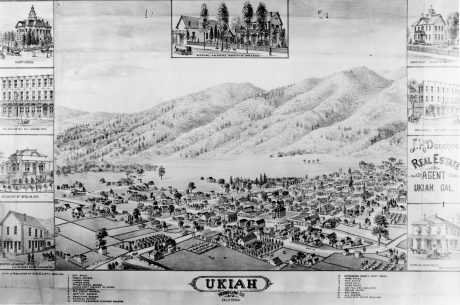
The City of Ukiah lies in the Ukiah Valley, the ancestral homeland of the Pomo peoples. The people referred to as “the Pomo” were, in fact, members of over 70 politically independent “village-communities,” or societies, located in what is today, Sonoma, Mendocino and Lake Counties. Each of these Pomoan peoples had its own name, home territory and distinct identity, speaking one of seven different languages. Ukiah was formerly part of the Yokayo grant—a Mexican land grant filed by Cayetano Jaurez that consisted of what is today the Ukiah and Redwood Valleys. The name Ukiah derives from the Yokaia people who lived in the village of Shokadjal, east of the Russian River at the south end of the Ukiah Valley. Yokaia means south valley people or people of the south valley. The Pomo had an oral culture and the name was likely first written down by the Spanish who wrote what they heard, Llokaya or Llokayo. Anglo-Americans similarly wrote down what they heard to their English-speaking ears, Yokaya or Yokayo. English further morphed it into Ukia, and finally Ukiah.
The first while settler in the valley, John Parker, arrived in the early 1850s. He was hired as a vaquero and built a corral and block house a few miles south of present-day Ukiah. Samuel Lowry was next and in 1856, he built a log cabin on what is today the SW corner of Main and Perkins Streets. The following year, he sold his claim to Absalom T. Perkins and Perkins moved his family into the valley. Perkins and John R. Short built and donated Ukiah’ s first public schoolhouse in 1858; Fred S. Dashiel was the first school teacher. That same year the first post office was established with Harrison Standley as postmaster. In the late 1850s, E. Pryor established a water-powered sawmill on Ackerman Creek, five miles northwest of Ukiah, marking the beginnings of a lumber industry.
Ukiah’s first commercial area stretched north from Perkins’ house along Main Street and the first government offices were located in the second story of a building known as the “Musical Hall” on the east side of Main Street near the intersection of E. Standley Street. Ukiah’s first hotel, built by Standley, was across the street to the west. Though Mendocino County was established in 1850, at the time of statehood, it was under the administration of Sonoma County until 1859, due to an initially minor white settlement. At the time, Ukiah and Capella rivaled each other in importance and were both in consideration to become the county seat. Ukiah came out ahead and a new two-story brick courthouse and jail was completed in January 1860, at the current courthouse site. Around the same time, E. R. Budd established the first newspaper called the Mendocino Herald—a Republican paper— just south of Perkins’ house. Four years later, in 1863, A. T. Perkins & Co founded the Constitutional Democrat so that citizens had a choice of news platforms.
G.B. Mathers built the town’s original drug store in 1861. The Methodist Episcopal congregation, led by Rev. W.S. Bryant, built Ukiah’s first formal church structure in 1862. Stephen Holden’s sawmill, built in 1861, was probably the first mill within the town of Ukiah. By 1865, Ukiah’s commercial center was spreading west to State Street. A. T. Perkins platted Ukiah’s first subdivision of 13 lots along East Perkins in 1868. In the 1870s, residents began to build homes further from the city center on the west side of the courthouse block along Oak, Pine, and Bush Streets.
After the U.S. District Court confirmed the boundary surveys and title on the Yokayo Grant on December 18, 1864, the town grew rapidly. Many settlers arrived with money earned from successful gold prospecting, and significant land sales began in May of 1866 with lots starting at $2 to $11 per acre. By 1870, the population tripled to 300, and by 1872, the town numbered 1,000 citizens.
On October 6, 1871, the Western Addition was created to meet the growing residential needs of the city. Bordered by Bush Street on the east, Barnes on the west, Smith on the north and Clay on the south, the Western Addition became the new fashionable place to live. The town’s most prominent citizens soon located there, and the area became known as “Knob Hill.” The first home built in the new addition at 614 West Standley. In 1872, a petition to incorporate Ukiah as a city was filed with the Mendocino County Board of Supervisors. As platted, the city was to extend one-half mile from the courthouse in four directions, making a one square mile city with the courthouse at the center. The first town officers were: J. R. Moore, E. W. King, M. D. Orr, T. L. Carothers, Samuel Orr, and R. N. Willing, Trustees; Thomas Chalfant, Marshal; and I. Isaacs, Treasurer. However, this first attempt at incorporation failed during the election of 1874, when candidates either failed to qualify or refused to serve. A second incorporation attempt in 1876 was successful.
Also in 1872, the Maxim Gas Company obtained permission to erect a gasworks and introduced gas lighting to Ukiah. Prosperity continued in 1873, when the Bank of Santa Rosa established a branch in Ukiah, the city’s first such institution, with A.F. Redemeyer serving as president. Maxim Gas Co. laid Ukiah’s gas mains in 1877, and the town placed street lights on prominent corners. Ironically, these same street lights were ordered removed just one year later. The Ukiah Water Company also laid mains in 1877, and the town purchased a Babcock hook and ladder truck for $700 for the newly-formed Eagle Fire Company, whose foreman was C.W. Tindall.
Although there was talk of bringing a railroad to Ukiah as early as 1862, the county did not even have enough money at that time to build and maintain a useable, year-round dirt road connecting Ukiah with other county towns. The railroad would finally reach Ukiah in 1889. James M. Donahue organized the Cloverdale & Ukiah Railroad Company on August 17, 1886, as an extension of his late father’s existing San Francisco and North Pacific Railway (SF&NP). In keeping with the interests of his late father, Colonel Peter Donahue, James’ intention was to extend the line 28.5 miles north from Cloverdale to Ukiah. On March 13, 1889, four miles from completion, financial troubles caused the sale of the property to the newly-reorganized SF&NP. The SF&NP then completed the line into Ukiah, giving it a mainline from Tiburon to Ukiah. Ukiah remained the northern railhead of the road until 1898, when construction northward toward Willits began. When the railroad arrived in Ukiah, it ran just east of Main Street and changed the complexion of this area. East Perkins rapidly developed into a commercial and industrial area with planing mills, warehouses, and a stockyard comprising the major establishments. establishments.
Until the arrival of the railroad, Ukiah had been a isolated town in the interior of Mendocino County. Therefore, the improved transportation brought by the railroad’s arrival caused a boom for local business, centering around agricultural products. The area around the depot became a major economic hub for the city, with numerous produce packing and shipping companies located there.
The most extensive crop in Ukiah was hops, and it was said that every farmer had at least some hops on his land. In the early 1900s, there were approximately 2,000 acres in the area devoted to growing hops, and Ukiah hops were reputed to be of the best quality in the state. In 1905, the railroad shipped 2,500,000 hops roots from Ukiah. The railroad also stimulated increased fruit growing. The most extensive crop in Ukiah were prunes with 200 acres devoted to this crop by 1913. Other locally important crops were pears, corn, alfalfa, and small fruits such as grapes, strawberries, gooseberries, and blackberries. Area farmers established a green bean cannery in Ukiah in 1908.
In spite of increased agricultural production brought about by improved transportation, most crops grown in the Ukiah Valley were consumed locally. By and large, Ukiah residents purchased and ate locally-grown produce and locally-raised beef. Even with improved transportation, most local farmers devoted a portion of their acreage to growing feed for their own livestock because of the cost of shipping feed into the city. By 1908, Ukiah had an important dairy industry supported by alfalfa grown in the river bottoms. Agriculture remained important well into the 20th century.
There was a considerable amount of timber in the surrounding area, consisting of redwood, white fir, oak, and pine. Most of the timberland was privately owned. By the early 20th century, lumber had become Mendocino County’s most important industry. Municipal improvements continued through the years. The county built a new courthouse in 1872 for $40,000. By the 1890s, the streets of Ukiah had been resurfaced, and sidewalks and gutters installed around the courthouse block. In 1896 the city awarded F. Brunner & Son the contract for the town’s sewer system for $15,900, and though some resisted, the citizens connected to the new sewers and filled in their wells and privies. Ukiah received electrical power in 1900 when the city established its own electrical company; the utility remained under municipal control through 1950. In 1911, the city paved State Street from Gibson Creek to Stephenson, as well as the streets surrounding the courthouse block.
Fires in 1881 and 1889 were considered two of Ukiah’s most significant for their destruction of downtown commercial properties. The earthquake of 1906 that so devastated San Francisco also damaged several commercial buildings in Ukiah, though minor compared to Willits and some coastal towns. Finally, in 1917—later referred to as “the year of the big fire”—a major fire in the downtown Ukiah destroyed twenty business structures and eleven residences on both sides of State Street from Perkins to Stephenson. Thus, much remodeling, rebuilding, and removal of structures had taken place in downtown Ukiah by the end of the 1920s.
The 1920’s construction of the Redwood Highway (later Highway 101) brought further transportation improvements and growth to Ukiah, stimulating increased tourism and traffic. Through Ukiah, the route ran down State Street. In 1919, the city acquired about 14 acres of Todd’s Grove, long used by residents for picnics and outings, and developed part of it into an auto park for tourists. The acquisition was spurred by local citizens’ concern over the prospect that the grove on the property was to be sold as firewood. By the following year, the Dispatch Democrat reported that the auto camp, called the “City Auto Tourists Free Camp,” was very popular with the touring public. The “autoists,” as they were called, spent an estimated $2,000 in Ukiah each touring season for gasoline, tires, accessories, and food. At about the same time, completion of the Ukiah to Lake Tahoe highway (Highway 20) as part of the state’s lateral highway system also facilitated transportation and tourism. In 1928-29 the city council approved the money to pave the streets, install gutters, and install landscaping and new street lights throughout the downtown. These improvements set the tone for Ukiah’s future street system.
The Great Depression, so devastating to many other communities, had little effect on Ukiah, as the city had long relied on its own resources. Indeed, during the 1930s, public building construction increased. Ukiah received WPA funds for the construction of rock walls, a swimming pool, and a golf course at Todd Grove Park.
Similarly, the self-sufficient city did not experience an appreciable wartime boom. However, after World War II, the nationwide demand for lumber to build new houses for returning war veterans created what has been called the “Lumber Rush of 1949” in northern California. Redwood was the pre-eminent wood of the day, and lumber camps and mills sprang up to provide a voracious marketplace with the “red gold.” Between 1941 and 194 7, the number of sawmills in Mendocino County nearly quadrupled. In 1950, the Masonite Corporation began operations at their new Ukiah plant, utilizing wood by-products to manufacture its unique product. Masonite remained the city’s largest private employer until its closure in 2001. The boom also created jobs in the Ukiah Valley, and increased the population from a pre-war figure of 3,731 to a postwar figure of 6,135. That increase in turn created a demand for new housing and schools. In 1941, Ukiah made its first new annexation since 1892. By 1950 Ukiah had gained five new additions, both to the north and south of the downtown core, increasing the city’s physical size by about half again.
The county, experiencing similar growth, responded in part by tearing down the venerable old courthouse in the heart of Ukiah, and building a larger, modern edifice to replace it. By the mid-1950s the boom began to wind down. The now larger, less self-reliant city was vulnerable to the economic vagaries of the country. When the federal government stopped giving easy credit for veterans housing, many lumber mills ceased operation and jobs vanished. Nonetheless, in the late 1950s the city redeveloped School Street between Church and Stephenson. Yokayo Shopping Center was erected shortly thereafter and Deep Valley Shopping Center was constructed at the south end of town. The Army Corps of Engineers constructed Coyote Dam about 1960, creating Lake Mendocino, in the process buying up many of the area’s pear orchards. In 1965, Caltrans turned Highway 101 into a freeway that bisected the Ukiah Valley longitudinally, bypassing Ukiah and routing through traffic off of State Street and out of the center of town.
[2] Kasch, Charles, “The Yokayo Rancheria,” California Historical Society Quarterly 26, no. 3 (1947): 209–215, https://doi.org/10.2307/25156041.
[3] Ogden Hoffman, Reports of Land Cases Determined in the United States District Court for the Northern District of California: June Term, 1853 to June Term, 1858 (San Francisco: N. Hubert, 1862), 46.
[4] Palmer, Lyman M. History of Mendocino County, California. San Francisco: Alley, Bowen & Co., 1880, 475-479.
[5] Palmer, 477.
[6] Palmer, 503.
[7] Palmer, 287.
[8] Palmer, 477.
[9] Palmer, 287.
[10] Palmer, 234.
[11] Palmer, 477.
[12] Ukiah Historical and Architectural Survey Update. Sacramento: P.S. Preservation Services, 1999.

The Condensed History of Ukiah was provided the the Historical Society of Mendocino County.
For more information about their organization, please visit https://www.mendocinocountyhistory.org/